
After months and months of legal wrangling I’ve moved house – goodbye ironstone cottage, hello 1980s brick – and with it I’ve acquired something I covet: a large writing studio all of my own. This is absolutely, completely unnecessary, as today actually proves, because I’m writing this in a café to escape the noise of builders fitting solar panels to the roof. Actually, the quiet café is also completely unnecessary, as my MA actually proves, which I wrote at a desk in the main room of our flat above the Caledonian Road: I put in headphones and played white noise through an app to block out the noise of the TV. I even soon stopped noticing ambulances wailing towards the Whittington hospital from their nearby station. To be fair, as soon as I could I wrangled an actual private space in the back bedroom for my PhD, and am in awe of writers who work on their phones in between looking after babies and focus their frazzled brains into stray gaps of time.
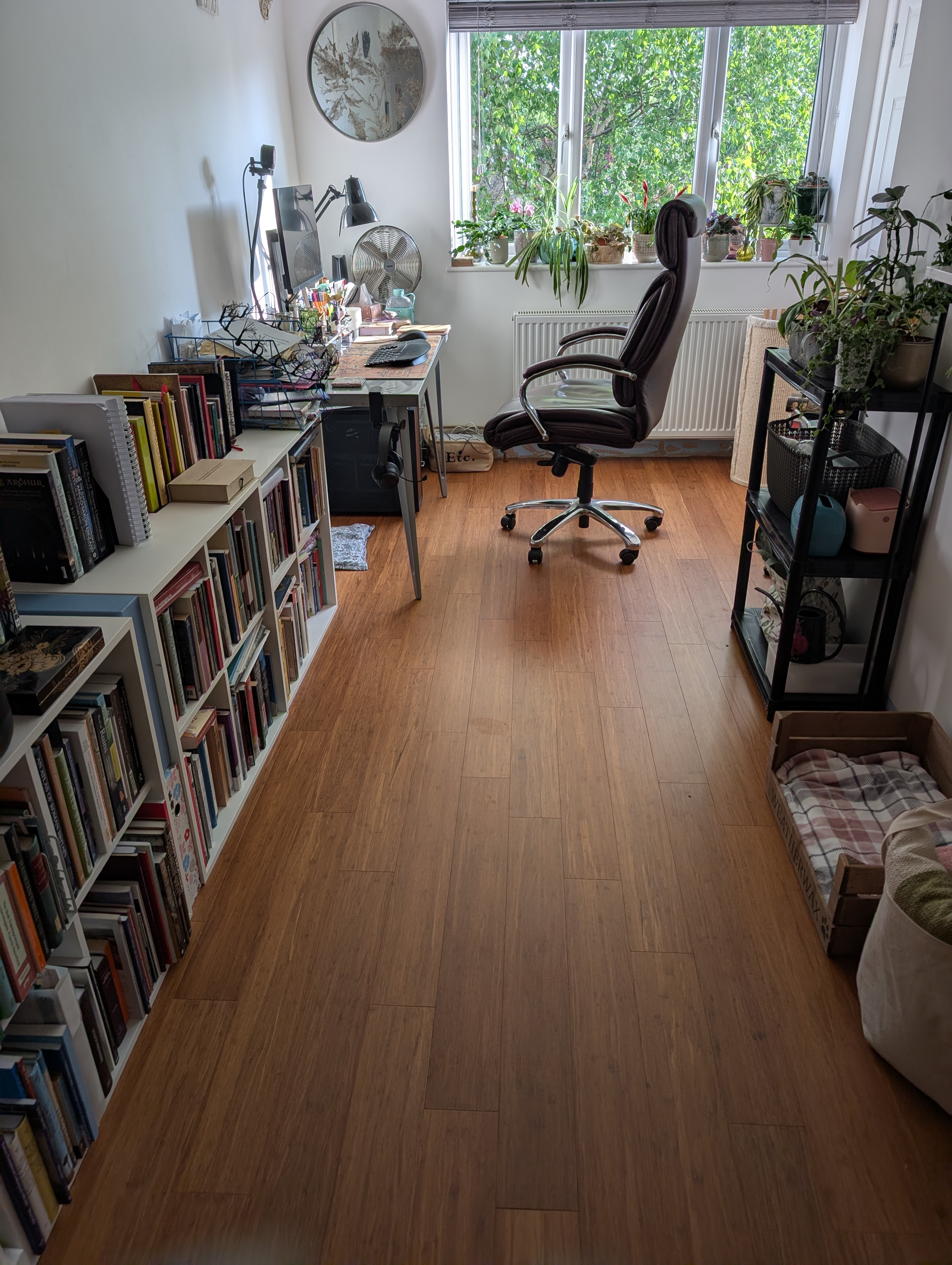
During the house-hunting angst, someone told me that there are only two types of houses that England values, the rural mansion and the country cottage, which perhaps explains why I feel the need to explain why I chose to trade my very pretty Victorian ironstone for 1980s brick. (See above: possession of a writing studio. Also: an entire walk-in airing room, as well as what is basically a library. Also: cottages are impossible to adequately heat). Houses are lifestyle stories made concrete reality.* These are powerful stories that go back to antiquity. Status-obsessed Romans like the architect Vitruvius wrote about town houses and rural retreats, and above all about how houses should fit a man’s position in life. Politicians absolutely needed better facilities than Joe Ordinary. Cicero wrote not-very-private letters about his villa at Tusculum, mansplaining how very important busy men needed a bit of peace and quiet. The houses of well-off Roman men had small rooms called cubicula (singular: cubiculum), which were mostly used for sleeping, sex and entertaining close friends, but also as offices. Quintilian praises the virtuosity of men writing by one single source of light, which is also mentioned by writers such as Varro, Cicero and Pliny. Roman women probably wrote in these spaces too, but we have frustratingly few of their letters and other writings and these don’t tell us. Archaeology shows that these small rooms usually fell short of Roman idealism, and rooms were generally multifunctional, being used for lots of things including storage, even if outdated museum displays occasionally still label them as ‘offices’ or ‘bedrooms’. People with considerably smaller homes also used to write too, as shown by the styli and writing tablets found in houses outside the forts at Vindolanda, as well as rural locations in Britain.
The privileged luxury of having a room just for writing is inscribed in the title of Virginia Woolf’s essays about women literally needing rooms of their own to have the freedom to write. Her essays are probably much more complex than how the story has become paraphrased in my head – I’ve never read them because her life has always seemed so distant from mine, and maybe I’m being unfair but unlike Cicero and co, she seems to want to advise me. Sorry, Virginia, my writing studio, love it as I do, is recent utter privileged luxury. I’ve always written whether I’ve had a room to or not. The fact that I don’t need the room is actually a kind of anti-story, the stories that seem to dictate truths that aren’t actually true – these are the sort of stories that we are told over and over again until we believe them. Even Elizabeth McCracken seems trapped by this. Her book ‘A Long Game: How To Write Fiction’, gives writers a kind of freedom through permission to ignore writing advice. But even she says “Instinctively I believe that nobody can write well unless locked in a distractionless cell of their own making, because I cannot. Logically I know this isn’t true…”
As McCracken always does, however, she finds you more options (oh did I say how much I love her book?). Her students find ways of using noisy cafés and other spaces to work. Some stories are inescapable – human beings do need safety, and dry and warm places to live (goodbye, draughty ironstone cottage). We also need enough room – the rebranding of overcrowded poverty as ‘Van Life’ and ‘Tiny Homes’ is a rather disgusting new and monetised take on the virtuously poor woodcutter’s cot. So many stories though are just bad and limiting, prison cells more than comfy living rooms. Luxury or not, I’m really happy with my new home – and especially enjoying my completely unnecessary writing room.
*My internal critic snorts that this is an airy fairy statement and houses are just a roof over your head, which is indeed a story.

 Dr. Claire Millington
You must be logged in to post a comment.