
I’m working on some new fiction (which it’s far too early to say much about) and part of my research was a visit to the History of Science Museum at Oxford to see their magical and alchemical objects. This marble copy of an engraving of John Dee’s Holy Table in particular caught my eye.

Dee was an adviser to Queen Elizabeth I, and with his skryer Edward Kelley, claimed to have conjured a series of angels. This I know from the museum label, and the museum’s website.* Or at least the museum gives this information and I’ve no reason to doubt it. More interesting to me – and to my research, which is into the late seventeenth century – is that this is a marble copy of an engraving made in 1659 of Dee’s original wooden table, which is now lost.** The loss of the original object, and relying on a series of copies is wryly familiar to me, both as a classicist and an epigrapher. The museum concludes that this copy is part of the evidence for a continuing interest in the occult almost a hundred years after Dee. I tend to agree with this finding: it’s often hard to work out exactly why something was made, but this inscribed marble would have been an expensive commission. Realistically it suggests Dee’s work was popular in the latter part of the seventeenth century, at least among some educated and wealthy people. His portrait below was gifted to Oxford University by Elias Ashmole, sometime student at Brasenose College and another target for my research.***

The museum information and the object it describes were satisfyingly cohesive to me on my casual visit, and if I wanted to do further research, I feel that it would be fairly easy to check the information offered and rationale for the curator’s conclusions and I could branch off into further questions to satisfy my interest in seventeenth century magic. The museum label and its webpage are clear and this functional presentation encourages a perspective of the object as evidence for history, as I’d expect.
A different perspective – a more exciting one, appealing both to my imagination and love of Phillip Pullman’s books – came from the ‘Lyra’s World’ exhibition. I’d dragged a friend along and we oohed and aahed, our imagination made real by seeing the gorgeous props from the BBC HBO series ‘His Dark Materials’, alongside the actual fact scientific objects that inspired Pullman.
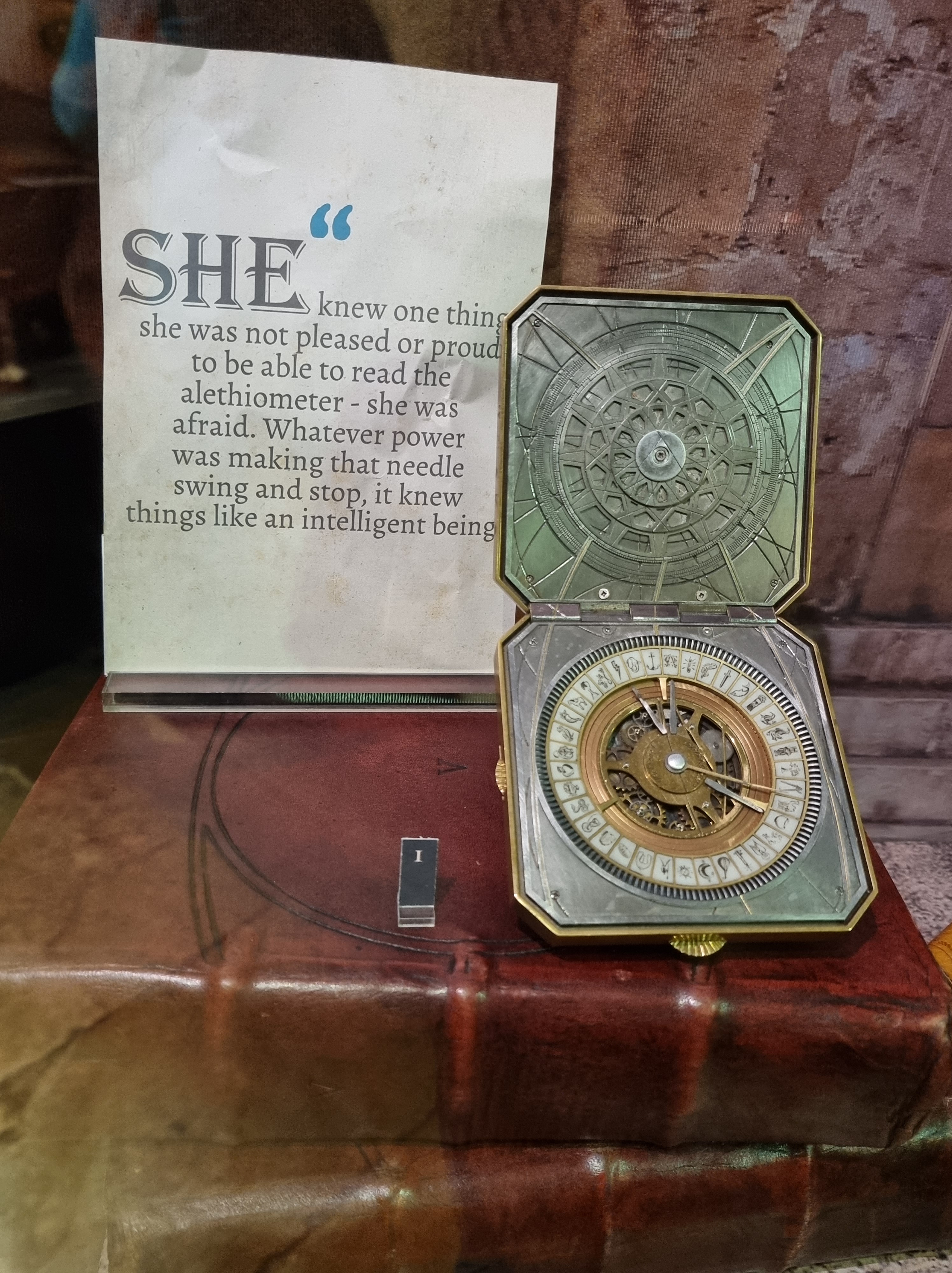
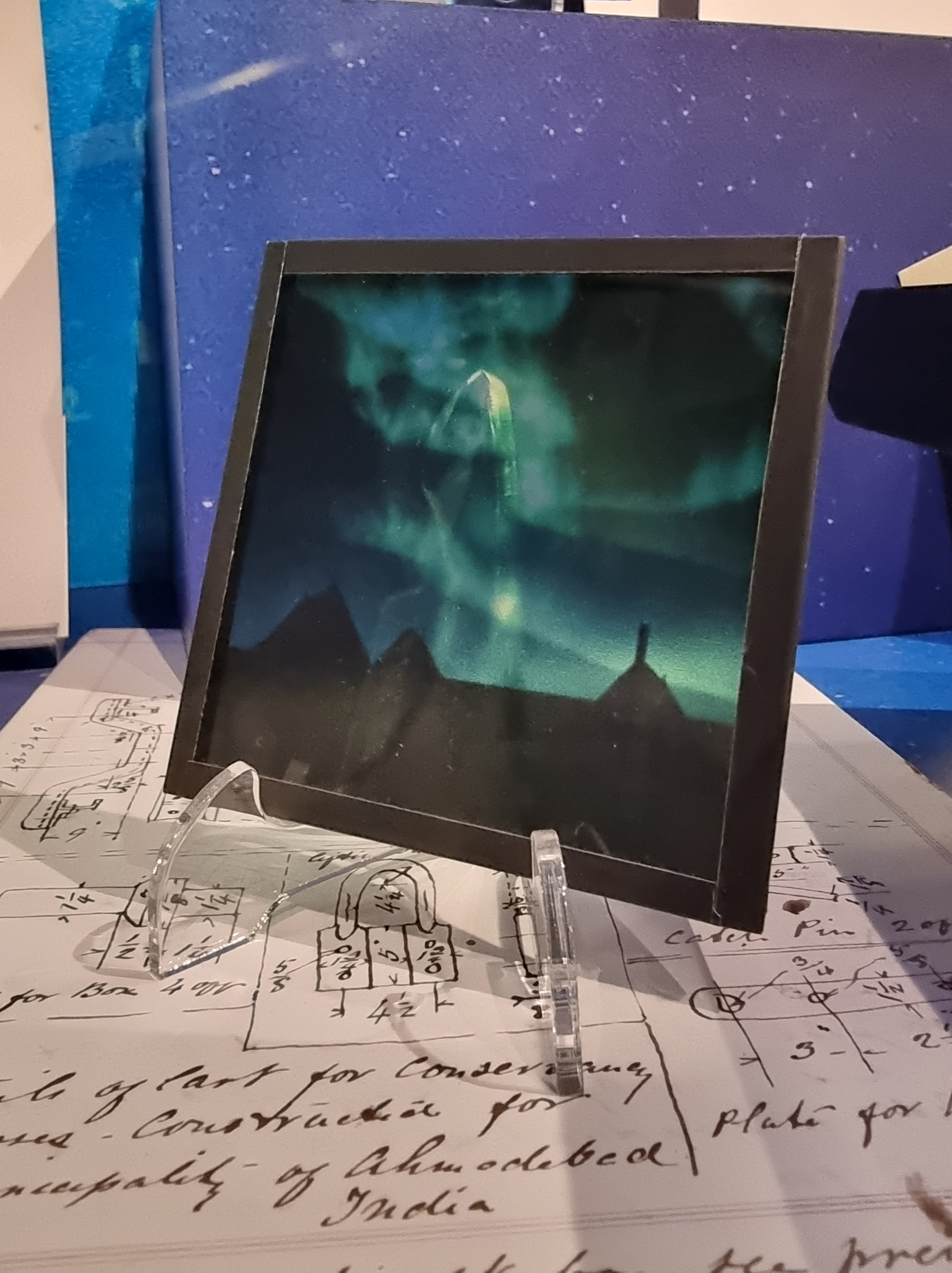

The museum case labels were exquisite, and through their artistry they brought the props and scientific instruments into the compass of Pullman’s world. Their perspective encourages imagination and feeling, seemingly unlike the presentation of the marble copy of Dee’s table I saw above.
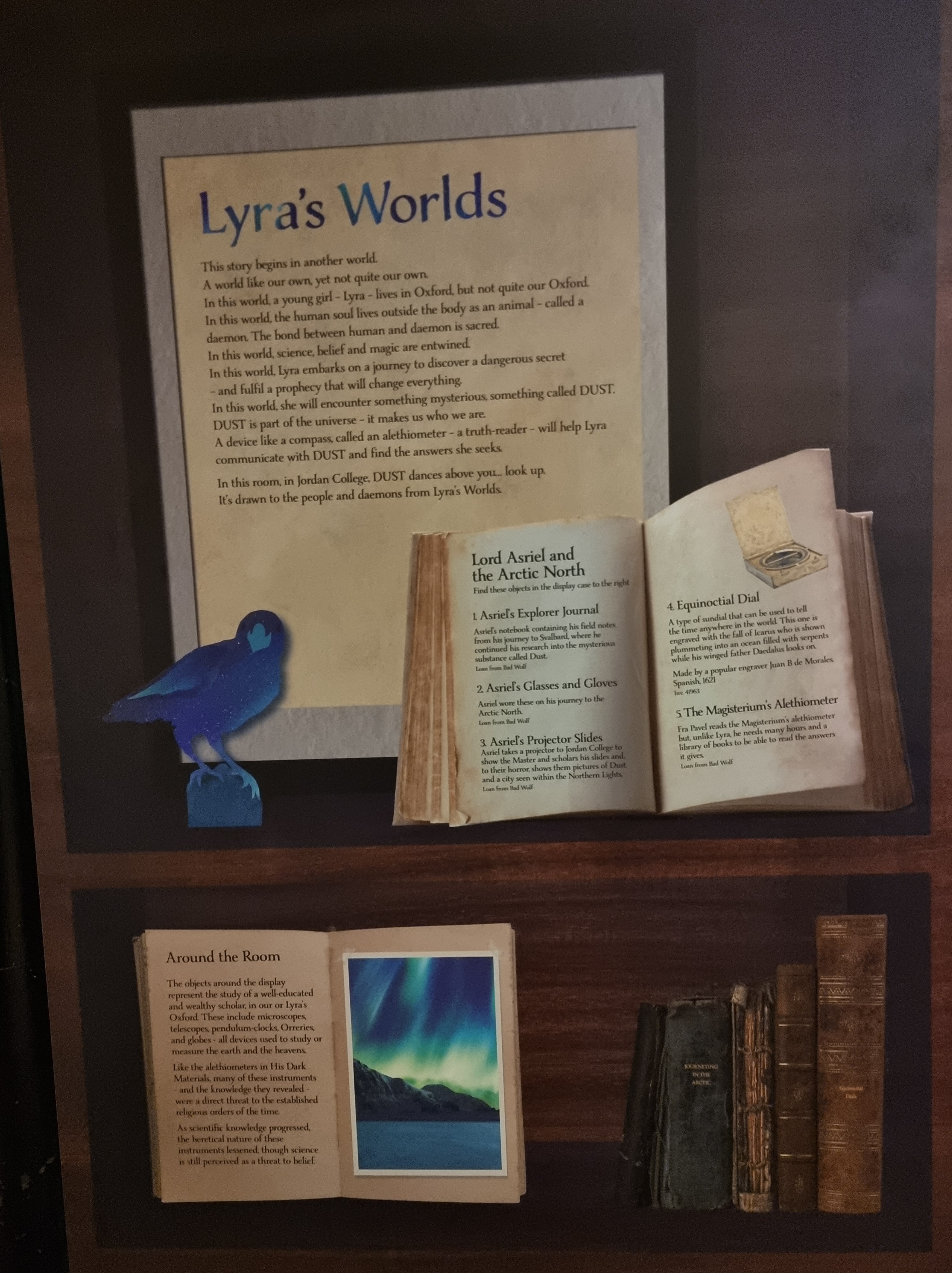
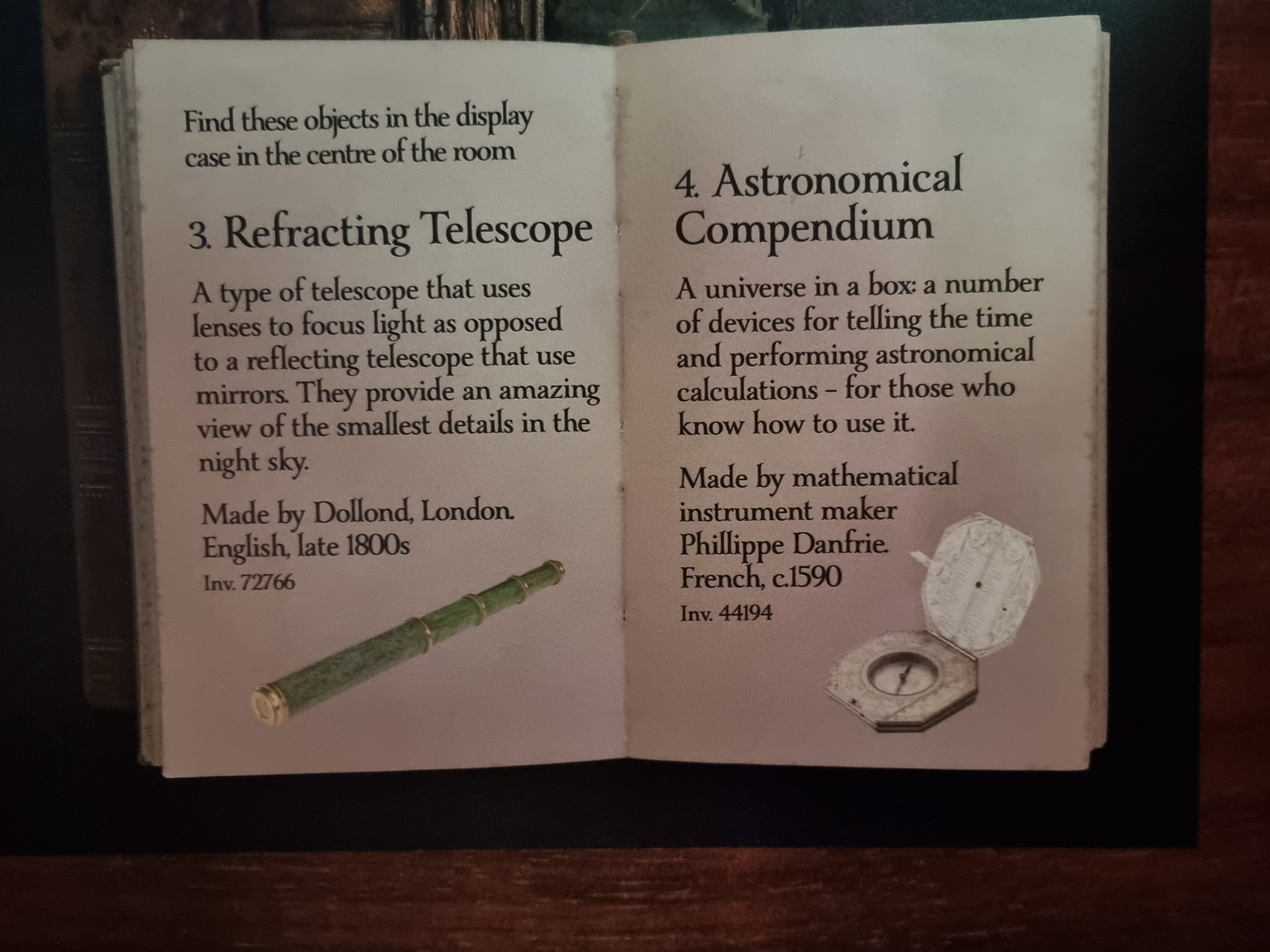
These labels contribute to an exhibition context that imagines the room as Lyra’s study at Jordan College, drawing you into the truth of its world even as it marks it clearly as ‘fiction’. It’s only at the surface though that this is different to the presentation of the marble copy of the engraving of Dee’s table. This is also a story, factual but also partial (maybe a now uncontroversial truth within museums). The slightly bland museum label for the marble table almost discourages imagination and thinking about the context in which the object is displayed – unlike in the Pullman exhibition this label tells a story without pointing out it’s a story its telling. Case labels are important and interesting; the museum conserves its old labels and lists them in its catalogue. Imagination too can be a helpful critical faculty, and I don’t really have an answer to its place within ‘factual’ exhibitions but it makes me think that, for example, the artists impressions and reconstructions that seem to have somewhat fallen from favour could more generally have a greater space?
‘Lyra’s World’ is spread across three museums in Oxford and I definitely recommend trying to go to the History of Science Museum’s chapter (which is free) before it closes at the end of December (the Story Museum and Pitt Rivers museum chapters seem to have different closing dates).
*https://www.hsm.ox.ac.uk/marble-copy-of-john-dees-holy-table
**It is a truth that should be universally acknowledged that it matters if it’s a copy of a copy of a lost thing. This is a hill this archaeologist will die on.

 Dr. Claire Millington
You must be logged in to post a comment.