Since I’m stuck mostly at home and avoiding like the plague (hah!) the normally normal chats and catch ups I enjoy, I’ve been spending an awful lot of time on social media. Which is no substitute at all for actually seeing people. And it’s horrible. Discombobulating. We are all experiencing huge disruption and know – if we’re lucky, only from the news – that terrible things have been happening. Nothing is normal any more and the future looks more uncharted, our assumptions do not hold.
Gone in the disruption are many of the quiet, private chats. The ones where you can show different faces that at least feel less ‘authored’ than those we present on Twitter and Facebook. I’m not suggesting that our more private faces are somehow more authentic – just that there are differences. We all know (don’t we) that how we present ourselves matters, even if it took a sociologist to say it in so many (a lot) of words:
“Face is an image of self, delineated in terms of approved social attributes – albeit an image that others may share, as when a person makes a good showing for his profession or his religion by making a good showing for himself .”
Goffman 1967
This is what I’m finding tough I think. I know that life is disrupted for everyone in lots of different ways. But at the personal level that’s not what I’m seeing discussed. Where can I say (repeatedly) that I’ve had a bad couple of weeks, that it’s getting to me, the uncertainty, the grief, the fear and disappointment of this year? That I’d been home for so long with illness last year and my health’s improved so much that I was looking forward so so much to doing some ordinary things, coffees with friends, working in the library? That even though I’m pretty fortunate this year is tough? That I’m around to give and also need to get some support? Phone calls with friends and conversations at home have become the absolute mainstay of keeping afloat. I wish though that the professional dumbshow that social media demands didn’t demand quite so much silence about real problems, about mental health or financial difficulties. Or any of the many things that mostly go unspoken.
Back though to Goffman – he’s still my go-to sociologist (even if that quote’s a bit old and I don’t really have much to do with sociologists, sorry) because he’s quite useful in thinking through some sources I’m using for my PhD. These are a series of letters sent between Claudia Severa and Sulpicia Lepidina, two wives of commanders stationed at forts up by Hadrian’s wall in the first century (i.e., before that wall was built).

The women write not exactly lively accounts of their lives to each other, more a sort of polite filling in the gaps between the in-person conversations they mention in their letters and they obviously had on a frequent basis. Or at least we know what Severa writes about –Lepidina clearly wrote back but her letters are long lost. Severa’s letters are not entirely complete but you can clearly get the gist.
“… greetings. Just as I had spoken with you, sister, and promised that I would ask Brocchus and would come to you, I asked him and he gave me the following reply, that it was always readily (?) permitted to me, together with …. to come to you in whatever way I can. For there are certain essential things which …. you will receive my letters by which you will know what I am going to do …. I was … and will remain at Briga. Greet your Cerialis from me. Farewell my sister, my dearest and most longed-for soul. “
Tab.Vindol. 292 (trans. Bowman)
Most of the text is written out by a military scribe, probably at Severa’s dictation although Severa could write and in fact did handwrite herself.
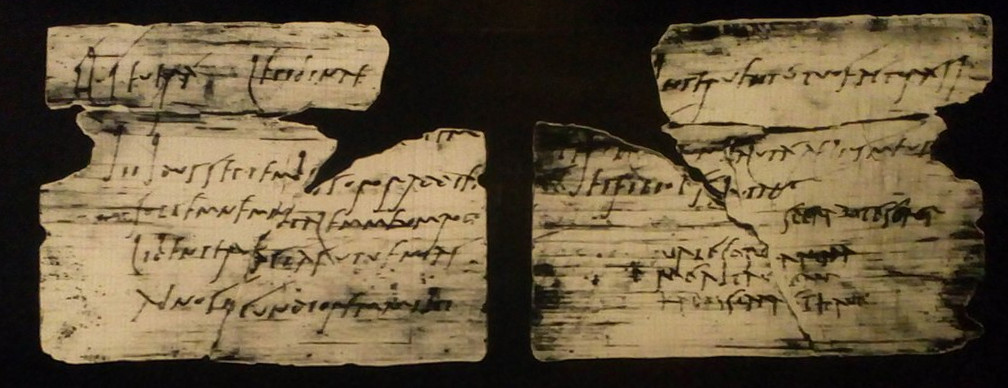
Once you get over boggling at the survival of writing on thin slips of wood about the size of postcards (the basic science: they were excavated from muddy, anaerobic contexts where things don’t rot) they are still fascinating. They are somewhat frustrating in that the women don’t talk in their letters directly about what – compared with their normal posh lives – must have been privations and extraordinary events. Almost certainly these women will have travelled – commanders wives seem mostly to be from similar backgrounds to their husbands – before being stationed in frontier forts a long way from their regular friends and family. They do however write with a sharp focus on the pleasure that each others visits will bring. These meetings, these conversations were important and to be savoured.
Now though we’re not talking about that are we? In the professionalised, highly-mediated contexts of social media we’re not saying how much we miss these meetings, those conversations that we have. I don’t really know why, but I think it’s making things harder.

 Dr. Claire Millington
You must be logged in to post a comment.