
Day of sofa sitting yesterday as clearly I did ‘too much’ last week. I hate this. Walked as far as the garden shed and back and that was it.
Better though this morning and following the lure of a paper found via Twitter: Steiner (2017) ‘Beyond the Foreign Office Papers: The Making of an International Historian’,1 which has some quarry in at least nine wives mentioned in connection with their husband’s work. Perhaps the most notable is the wife of Owen O’Malley, himself in 1943 appointed ambassador to the Polish government and asked to report on the responsibility for the mass graves of Polish officers which advancing German troops had just discovered at Katyn, near Smolensk. 2 Asked in effect to choose between writing the truth as he knew it to be, and the answer required by the government, he opted for the former and came very close to losing his job entirely. In the end he was downgraded and his career progression curtailed. 3 Plus ça change. 4
Steiner writes however of “the prodigious efforts of his wife – who sought interviews with Sir Warren Fisher, the head of the civil service and one of O’Malley’s judges, but also with many of the senior Foreign Office figures, Labour leaders, lawyers and friends with influence – that the verdict that O’Malley should resign from the service was dropped. The full story is told in her book, in Permission to Resign: Goings on in the Corridors of Power.” The interrelationship between the clear impact that these diplomats’ wives had and the unofficial and uneasy position that they held in relation to the Foreign Office (as it then was) is resonant with the positions and roles of the wives that I research within the imperial Roman army. Another book for me to find then.
Her paper reminds me of something else too, that I knew from my own work as a diplomat but irritatingly had drifted out of focus. The Foreign Office and the Colonial Office used to be different beasts, and the FCO building on King Charles Street used to be four separate buildings around one quad housing the Foreign Office, the India Office, the Colonial Office, and the Home Office.
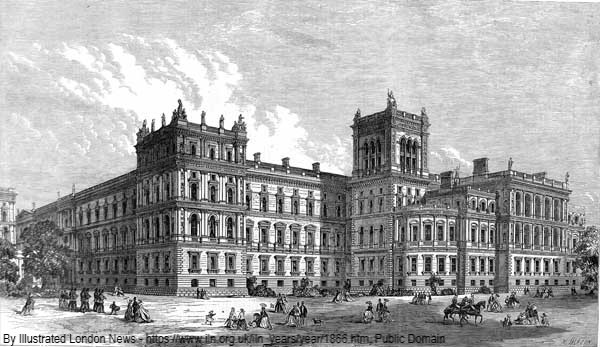
These were not connected internally, and rumour put about during my training had it that this was to stop junior civil servants wasting time chattering. This proved impractical however, and as part of the changing usages doorways still referred to as ‘holes in the wall’ were inserted. A nice analogy to consider with my analysis of spatial usage in forts.
The histories of the Colonial Office and the Foreign Office are quite distinct, although obviously part of the same imperialist system.5 Steiner writes that the men “who staffed the three consular services, still separately recruited by exam before the introduction of the 1943 reforms, trained in languages, not at a special establishment in England but through local teachers when taking up their posts. They were, with but a few exceptions, second class citizens, badly paid, rarely received by their ambassadors abroad and ignored when they returned to London.” Another lense then to use in considering the roles of the auxiliaries within Rome’s imperial expansion and maintenance.
Final thoughts: Steiner situates her paper somewhere between memoir and academic paper. It is a descriptive account of her relationship to her subject, told through her methods and foregrounding her relationships with the people whose papers and memories she used as her material. I’ve not entirely settled yet how I deal with my own interests that are inextricable from perspective on my research. All researchers I think have this to deal with and in some ways my task is perhaps easier because it was my perspective on the material that in part attracted me to this material. It’s really helpful though to have papers like this one to be able to think this through with.
- https://doi.org/10.1080/07075332.2017.1285798
- https://www.independent.ie/opinion/columnists/eoghan-harris/eoghan-harris-brave-mayo-mandarin-who-kept-katyn-in-focus-26650728.html
- See No.2 and https://api.parliament.uk/historic-hansard/commons/1928/apr/25/foreign-office-mr-omalley
- https://www.bbc.co.uk/news/uk-48939821
- https://history.blog.gov.uk/2014/12/08/administrators-of-the-british-empire

 Dr. Claire Millington
You must be logged in to post a comment.